Section V · Astroparticle Physics
Dark Matter: Evidence and Detection Strategies
The gravitational evidence for a non-luminous component of the universe is established beyond reasonable dispute; its particle nature is not. This section records what has been excluded and what remains.
Scope and methodology
This section summarises the observational evidence for dark matter and then compares four detection strategies: direct detection in underground detectors, resonant axion searches, indirect astrophysical searches and collider searches. Comparison is made on the candidate mass range probed, the flagship experiment, the best published limit, approximate cost or scale, and the planned successor. Sources are collaboration papers in refereed journals and preprints.
Evidence
Rubin and Ford's 1970 spectroscopy of the Andromeda galaxy showed that orbital velocities remain flat far beyond the visible disc, implying a mass distribution extending well past the stars.1 Weak lensing of the merging cluster 1E 0657-56, the Bullet Cluster, located the bulk of the mass away from the X-ray-emitting gas that holds most of the baryons, a configuration difficult to reconcile with modified gravity.2 The Planck satellite's 2018 analysis of the cosmic microwave background fixes the cold dark matter density at Ωch2 = 0.1200 ± 0.0012, corresponding to about 26 percent of the present energy density of the universe against 5 percent in baryons.3 Cosmological simulations that include this component reproduce the observed large-scale structure. A comprehensive historical review is given by Bertone and Hooper.4
Candidate particles
Weakly interacting massive particles (WIMPs) in the GeV to TeV range arise naturally in supersymmetric extensions of the Standard Model and would have been produced with the observed abundance through thermal freeze-out. Axions, pseudoscalars introduced to solve the strong CP problem, would have masses between a microelectronvolt and a millielectronvolt and behave as a cold field. Sterile neutrinos at the kilo-electronvolt scale, primordial black holes in the asteroid-mass window of 1017 to 1022 grams, and a broad class of sub-GeV hidden-sector particles complete the principal candidates. Modified Newtonian dynamics remains a minority alternative that accounts for galactic rotation curves but not for cluster lensing or the CMB acoustic peaks.
Direct detection
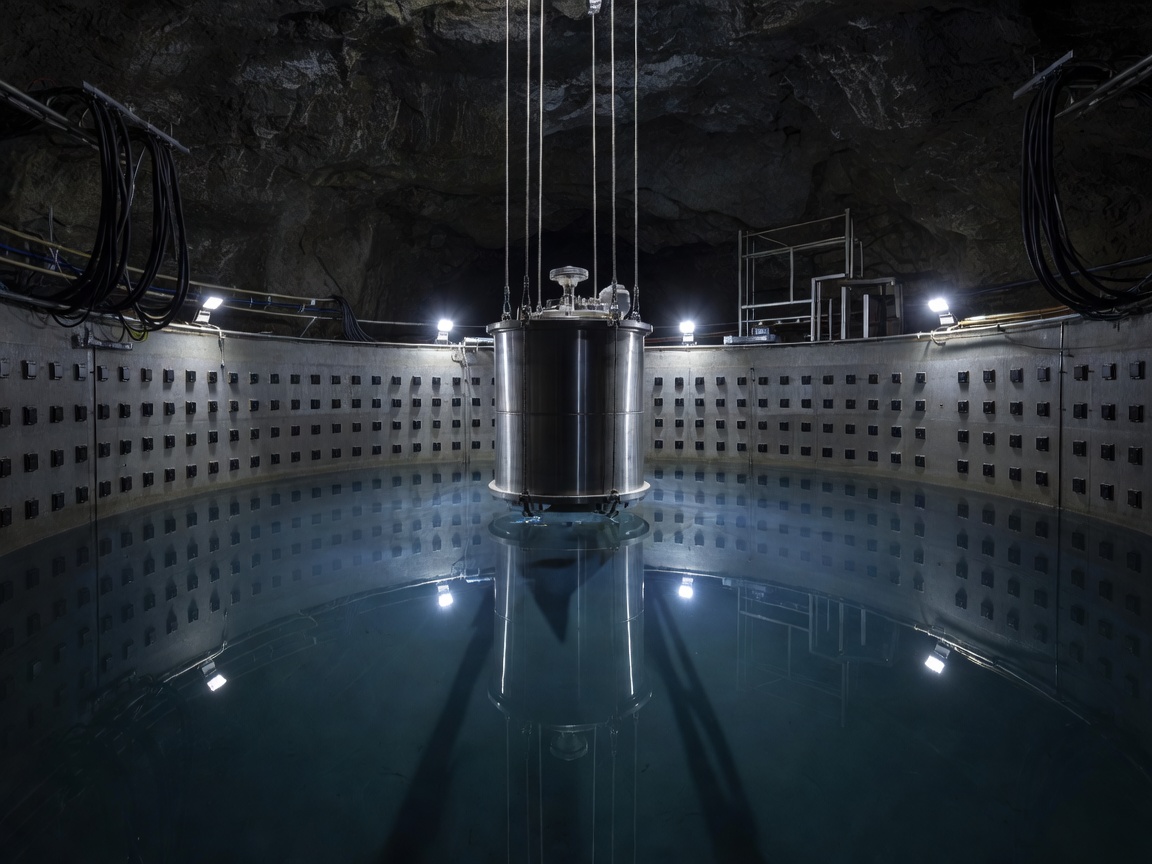
Direct searches look for nuclear recoils from WIMPs scattering in a shielded target. The current generation uses two-phase xenon time projection chambers of several tonnes. LUX-ZEPLIN (LZ), with 7 tonnes of active xenon 1,480 m underground at the Sanford Underground Research Facility, reported in 2023 a spin-independent cross-section limit of 9.2 × 10-48 cm2 at 36 GeV from 60 live days,5 and improved this to 2.2 × 10-48 cm2 at 40 GeV with 280 live days in 2024.6 XENONnT at Gran Sasso, with 5.9 tonnes active, set a limit of 2.58 × 10-47 cm2 at 28 GeV from its first science run,7 and PandaX-4T at Jinping operates at comparable sensitivity. Both XENONnT and PandaX reported in 2024 the first detection of coherent scattering of solar boron-8 neutrinos, marking the arrival of the "neutrino fog" that will limit future sensitivity. The LZ construction cost was approximately USD 55 million. The XLZD consortium proposes a 60 to 80 tonne successor. Below a few GeV, cryogenic germanium and silicon detectors such as SuperCDMS SNOLAB and skipper-CCD experiments such as SENSEI provide the leading limits.
Axion searches
The Axion Dark Matter eXperiment (ADMX) places a tunable microwave cavity in an 8 T field and searches for axion-to-photon conversion at the resonant frequency. It has excluded axions at the sensitivity of the DFSZ benchmark model between roughly 2.66 and 4.2 µeV.8 HAYSTAC at Yale and CAPP in South Korea extend cavity searches to higher masses using squeezed-state receivers; MADMAX proposes dielectric discs for the 40 to 400 µeV range; and lumped-element experiments such as DMRadio target masses below a micro-electronvolt. The International Axion Observatory (IAXO) would search for axions from the Sun rather than from the halo. Cavity experiments cost tens of millions of dollars and scan roughly one octave of mass per decade of operation.
Indirect and collider searches
Indirect searches look for annihilation products. Six years of Fermi Large Area Telescope observations of dwarf spheroidal galaxies exclude thermally produced WIMPs annihilating to b-quarks below about 100 GeV.9 The AMS-02 positron excess and the Galactic Centre gamma-ray excess remain unresolved between dark-matter and astrophysical explanations. At the Large Hadron Collider, ATLAS and CMS search for events with a single jet and large missing transverse momentum; the ATLAS Run 2 analysis of 139 fb-1 excludes axial-vector mediators up to about 2.1 TeV for a 1 GeV dark-matter particle.10 The High-Luminosity LHC, scheduled from 2030, will extend this reach modestly.
Comparative register
| Strategy | Mass range | Flagship | Best published limit | Next step |
|---|---|---|---|---|
| Direct, xenon TPC | 5 GeV – 10 TeV | LZ, XENONnT, PandaX-4T | σSI < 2.2 × 10-48 cm2 at 40 GeV | XLZD 60 – 80 t |
| Direct, cryogenic | 0.1 – 5 GeV | SuperCDMS, SENSEI | Sub-GeV leading limits | SuperCDMS SNOLAB full run |
| Axion haloscope | 1 – 400 µeV | ADMX, HAYSTAC, MADMAX | DFSZ excluded 2.66 – 4.2 µeV | ADMX Gen-2 high-frequency; MADMAX |
| Indirect, gamma | 10 GeV – 10 TeV | Fermi-LAT, H.E.S.S. | Thermal b-quark WIMP excluded < 100 GeV | Cherenkov Telescope Array |
| Collider | Mediator to ~2 TeV | ATLAS, CMS | Axial-vector mediator < 2.1 TeV excluded | HL-LHC from 2030 |
Assessment
- Direct detection has excluded the most natural WIMP cross-sections over three orders of magnitude in mass; the remaining parameter space above the neutrino fog will be covered by one further generation of detectors, after which the strategy saturates.
- Axion searches cover a small fraction of the plausible mass range and proceed slowly; they are the principal growth area of the field and the one in which a positive result is most plausible in the next decade.
- Indirect and collider searches constrain models rather than particles and are unlikely to establish a discovery on their own.
The null results to date are informative: the simplest thermal WIMP with weak-scale couplings is excluded, and attention has shifted toward lighter and more weakly coupled candidates. The register will record any claimed detection only when it is confirmed by a second experiment using a different target.
References
- Rubin, V. C. and Ford, W. K. "Rotation of the Andromeda Nebula from a Spectroscopic Survey of Emission Regions." Astrophysical Journal 159, 379 (1970). doi:10.1086/150317 ↩
- Clowe, D. et al. "A Direct Empirical Proof of the Existence of Dark Matter." Astrophysical Journal Letters 648, L109 (2006). doi:10.1086/508162 ↩
- Planck Collaboration. "Planck 2018 results. VI. Cosmological parameters." Astronomy & Astrophysics 641, A6 (2020). doi:10.1051/0004-6361/201833910 ↩
- Bertone, G. and Hooper, D. "History of dark matter." Reviews of Modern Physics 90, 045002 (2018). doi:10.1103/RevModPhys.90.045002 ↩
- LZ Collaboration. "First Dark Matter Search Results from the LUX-ZEPLIN (LZ) Experiment." Physical Review Letters 131, 041002 (2023). doi:10.1103/PhysRevLett.131.041002 ↩
- LZ Collaboration. "Dark Matter Search Results from 4.2 Tonne-Years of Exposure of the LUX-ZEPLIN (LZ) Experiment." Preprint arXiv:2410.17036 (2024). ↩
- XENON Collaboration. "First Dark Matter Search with Nuclear Recoils from the XENONnT Experiment." Physical Review Letters 131, 041003 (2023). doi:10.1103/PhysRevLett.131.041003 ↩
- ADMX Collaboration. "Search for Invisible Axion Dark Matter in the 3.3–4.2 µeV Mass Range." Physical Review Letters 127, 261803 (2021). doi:10.1103/PhysRevLett.127.261803 ↩
- Albert, A. et al. (Fermi-LAT and DES Collaborations). "Searching for Dark Matter Annihilation in Recently Discovered Milky Way Satellites with Fermi-LAT." Astrophysical Journal 834, 110 (2017). doi:10.3847/1538-4357/834/2/110 ↩
- ATLAS Collaboration. "Search for new phenomena in events with an energetic jet and missing transverse momentum in pp collisions at √s = 13 TeV with the ATLAS detector." Physical Review D 103, 112006 (2021). doi:10.1103/PhysRevD.103.112006 ↩