Section IV · Fusion Energy
Inertial Confinement and Alternative Fusion Concepts
The single facility that has achieved target gain above unity is set against the private programmes that promise electricity within a decade by other means.
Scope and methodology
This section compares laser-driven inertial confinement at the National Ignition Facility, proposed inertial fusion energy plants, and the magneto-inertial, field-reversed configuration and Z-pinch programmes pursued by private companies. Comparison is made on demonstrated gain, repetition rate, driver efficiency, fuel cycle and stated milestone. Physics results are taken from peer-reviewed publications; company milestones are recorded as published by the companies and are not independently verified.
The National Ignition Facility
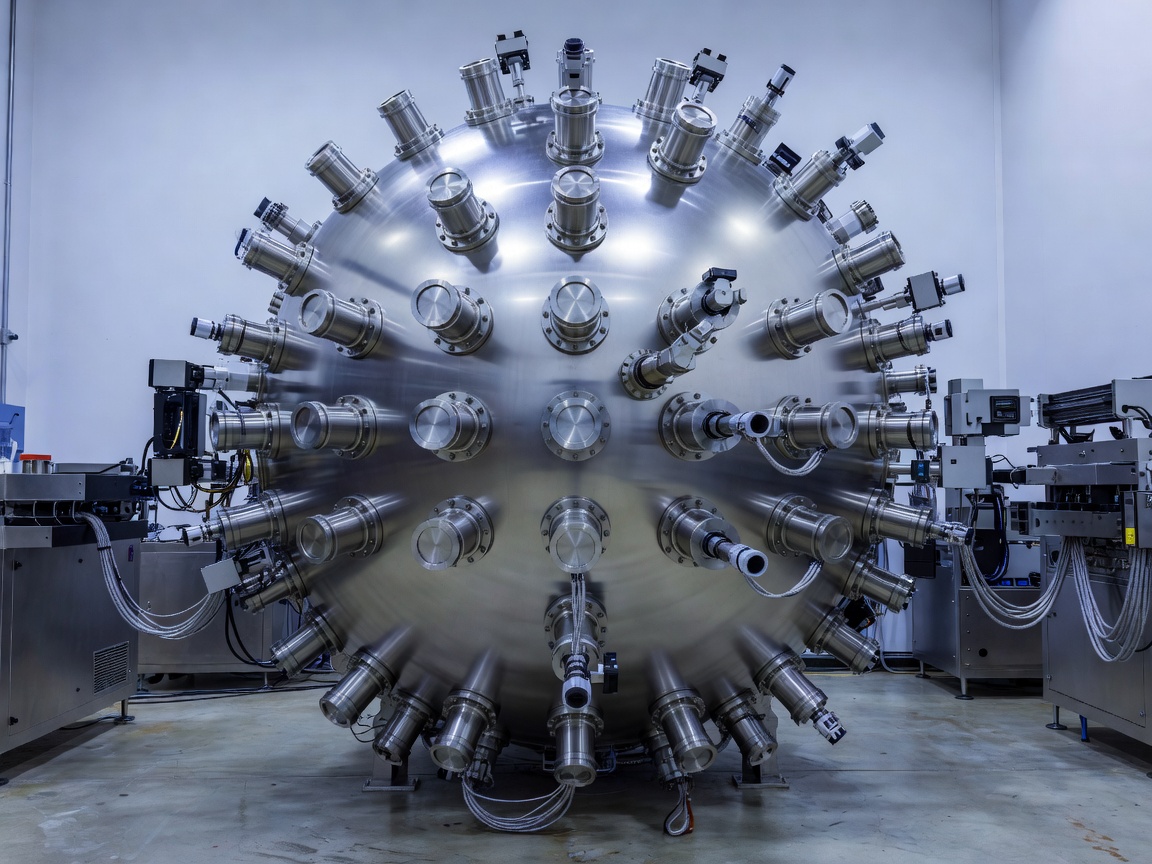
The concept of compressing a fuel capsule with lasers was set out by Nuckolls and colleagues in 1972.1 The National Ignition Facility at Lawrence Livermore National Laboratory realises it with 192 beams delivering about 2 MJ of ultraviolet light into a gold or depleted-uranium hohlraum, whose X-rays ablate a 2 mm capsule of deuterium–tritium ice. An August 2021 shot produced 1.35 MJ and was the first laboratory experiment to exceed the Lawson criterion for ignition.2 On 5 December 2022 a shot delivering 2.05 MJ of laser energy produced 3.15 MJ of fusion yield, a target gain of 1.5 and the first demonstration of scientific breakeven in any fusion device.3 Subsequent shots have exceeded 5 MJ with laser energy raised to 2.2 MJ.4
The result is a physics milestone, not an energy one. The flashlamp-pumped neodymium glass laser converts electrical energy to ultraviolet at less than one percent efficiency, so each shot draws roughly 300 MJ from the grid to release 3 to 5 MJ of fusion energy. The facility fires about once per day, its targets are hand-assembled at a cost of the order of USD 100,000 each, and it exists to support the United States nuclear stockpile programme rather than to develop a power plant.
Requirements for inertial fusion energy
A 2022 basic research needs workshop convened by the United States Department of Energy set out the gap between NIF and a plant.5 Target gain must rise from 2 to roughly 50–100; repetition rate from one shot per day to about 10 per second; driver wall-plug efficiency from under 1 percent to above 10 percent; and target cost must fall by three orders of magnitude to a few tens of cents. Diode-pumped solid-state lasers reach 10 to 20 percent efficiency at kilojoule scale, and excimer lasers offer efficient scaling to 10 MJ. Private firms addressing these problems include Xcimer Energy, which plans a 10 MJ krypton-fluoride driver; Focused Energy, pursuing proton fast ignition; Marvel Fusion, pursuing nanostructured targets; and Longview Fusion Energy Systems, which proposes to scale the NIF indirect-drive approach directly.
Magneto-inertial and field-reversed concepts
Magneto-inertial fusion compresses a magnetised plasma on microsecond timescales, intermediate between the nanoseconds of lasers and the seconds of tokamaks. Helion Energy forms two field-reversed configuration plasmoids, accelerates them to collision, compresses the merged plasma with pulsed magnets, and proposes to recover energy inductively as the plasma expands, avoiding a steam cycle. Its seventh prototype, Polaris, began operation in 2024–25 with deuterium–helium-3 fuel; the company holds a power purchase agreement to supply Microsoft with at least 50 MW from 2028 and has begun site work at Malaga, Washington.6 No peer-reviewed measurement of fusion gain from any Helion device has been published.
TAE Technologies sustains beam-driven field-reversed configurations. Its C-2U device held plasmas stable for 5 ms in 2015, a result published in the peer-reviewed literature,7 and its later Norman machine reported 75 ms durations and 70 million degree temperatures. TAE's long-term fuel is proton–boron-11, which produces no neutrons but requires ion temperatures near 300 keV, at which bremsstrahlung losses have historically been calculated to exceed fusion power.8 General Fusion pursues magnetised target fusion in which liquid lithium is driven inward by pistons; its LM26 demonstrator began compression experiments in 2025.
Z-pinch and projectile approaches
Zap Energy stabilises a Z-pinch with sheared axial flow, confining plasma with the magnetic field of its own current and dispensing with external magnets and lasers.9 Its FuZE-Q device operates at pinch currents of 500 kA and has reported electron temperatures of 1 to 3 keV; the design is compact enough that the company's Century platform integrates a liquid-metal wall and repetitive pulsed power. First Light Fusion in the United Kingdom pursued projectile-driven compression using a two-stage gas gun until 2025, when it redirected its business toward licensing its target amplifier technology.
Comparative register
| Programme | Concept | Fuel | Published result | Stated milestone |
|---|---|---|---|---|
| NIF (LLNL) | Laser indirect drive | D–T | Target gain 1.5 (2022); yield > 5 MJ (2024) | Research facility; no power objective |
| Xcimer Energy | Excimer laser IFE | D–T | Design stage | Multi-megajoule driver demonstration late 2020s |
| Helion Energy | Pulsed FRC merging | D–3He | Polaris commissioning; no published gain | 50 MW to Microsoft by 2028 |
| TAE Technologies | Beam-driven FRC | D–T; p–11B long term | 5 ms stable plasma (2015); 75 ms (Norman) | Da Vinci prototype 2030s |
| Zap Energy | Sheared-flow Z-pinch | D–T | 1 – 3 keV at 500 kA | Century platform integration |
| General Fusion | Magnetised target, liquid liner | D–T | LM26 compression tests | Scientific breakeven equivalent, late 2020s |
Assessment
- Scientific gain above unity has been achieved by one facility, NIF, and by no other approach in this section. It is the only inertial or alternative result verified in the peer-reviewed literature.
- Engineering gain, in which the plant returns more electricity than it consumes, has been achieved nowhere. For NIF the shortfall is a factor of roughly one hundred.
- Private programmes report stated milestones on timelines of five to ten years. The Fusion Industry Association's annual survey records cumulative private investment above USD 7 billion across some 45 companies.10 The historical record of large fusion projects, in which schedules have typically doubled, is noted.
The register will revise the status of any private programme when a fusion yield measurement appears in a peer-reviewed venue.
References
- Nuckolls, J., Wood, L., Thiessen, A. and Zimmerman, G. "Laser Compression of Matter to Super-High Densities: Thermonuclear (CTR) Applications." Nature 239, 139–142 (1972). doi:10.1038/239139a0 ↩
- Abu-Shawareb, H. et al. (Indirect Drive ICF Collaboration). "Lawson Criterion for Ignition Exceeded in an Inertial Fusion Experiment." Physical Review Letters 129, 075001 (2022). doi:10.1103/PhysRevLett.129.075001 ↩
- Abu-Shawareb, H. et al. (Indirect Drive ICF Collaboration). "Achievement of Target Gain Larger than Unity in an Inertial Fusion Experiment." Physical Review Letters 132, 065102 (2024). doi:10.1103/PhysRevLett.132.065102 ↩
- Lawrence Livermore National Laboratory. "National Ignition Facility: achievements and status." lasers.llnl.gov (accessed January 2026). ↩
- United States Department of Energy, Office of Fusion Energy Sciences. "Basic Research Needs Workshop on Inertial Fusion Energy." Report (2023). science.osti.gov/fes ↩
- Helion Energy. "Polaris and the Orion power plant." helionenergy.com (accessed January 2026). ↩
- Binderbauer, M. W. et al. "A high performance field-reversed configuration." Physics of Plasmas 22, 056110 (2015). doi:10.1063/1.4920950 ↩
- Nevins, W. M. and Swain, R. "The thermonuclear fusion rate coefficient for p–11B reactions." Nuclear Fusion 40, 865–872 (2000). doi:10.1088/0029-5515/40/4/310 ↩
- Shumlak, U. "Z-pinch fusion." Journal of Applied Physics 127, 200901 (2020). doi:10.1063/5.0004228 ↩
- Fusion Industry Association. "The Global Fusion Industry in 2024." Annual report. fusionindustryassociation.org ↩